Sustainable Procurement
Relevant SDGs

Because our Group engages in a variety of business activities, we must interact with an assortment of different partners, including suppliers. We aim to establish long-term, mutually beneficial relationships with our suppliers and engage in sustainable procurement practices. What follows is a brief overview of what we are doing in this regard.
Procurement Policy
The Seiko Group believes that by working with its suppliers to address sustainability challenges throughout the entire supply chain, the Group can build long-term trust with local communities and contribute to the creation of a sustainable society. In November 2022, we revised our Group Procurement Policy and established the Seiko Group Procurement Guidelines as a supplementary document to help both our employees and our suppliers carry out sustainable procurement activities.
Seiko Group Procurement Policy
The Seiko Group will fulfill its social responsibilities by contributing to the realization of a sustainable society through the implementation of our corporate philosophy - creating “A future filled with smiles all over the world” and of being “A company that is trusted by society.” To this end, the Group has established three key aims for its procurement policy: 1) Coexistence and co-prosperity with business partners; 2) Promoting procurement activities with proper consideration for the environment, society, and corporate governance; and 3) Fair and impartial evaluation of business partners.
The Group will expand its procurement activities globally based on these three policy aims, which are described in greater detail below.
1.Coexistence and co-prosperity with business partners
The Seiko Group and its business partners aim to build a relationship of mutual trust over the long term. It is our goal to continue to prosper together by helping each other.
2.Promoting procurement activities with proper consideration for the environment, society, and corporate governance
We will respect global social norms and work together with our business partners to promote responsible procurement activities that involve proper consideration for the environment, society, and corporate governance.
We will promote procurement activities that take into consideration the following factors (among others):
- Compliance with laws, regulations, and social norms
- Respect for human rights
- Protection of occupational safety and health
- Promotion of global environmental conservation
- Promotion of business continuity planning (BCP)
- Prohibition of bribes (including illegal gifts, payments, and benefits) to any stakeholder
3.Fair and impartial evaluation of business partners
We respect “fair, transparent, and free competition,” which is a fundamental rule of a freely competitive society, and we evaluate our business partners based on the following criteria:
- The partner must be active in environmental, social, and corporate governance initiatives
- The partner must be highly trusted as a company (Stable business conditions, appropriate risk management system, etc.)
- The partner must have technological capabilities that can contribute to Seiko Group products
- The quality, price, and delivery times of the items procured must be at appropriate levels.
We will conduct comprehensive evaluations based on these and other criteria.
We aim to improve the value of our entire supply chain by conducting business in accordance with this Seiko Group Procurement Policy.
Seiko Group Procurement Guidelines
We formulated the Seiko Group Procurement Guidelines and the accompanying Explanation of the Guidelines as references for the entire supply chain. These documents take into account our business environment and material issues while aligning with the Responsible Business Alliance (RBA) Code of Conduct (ver 8.0) and other criteria.
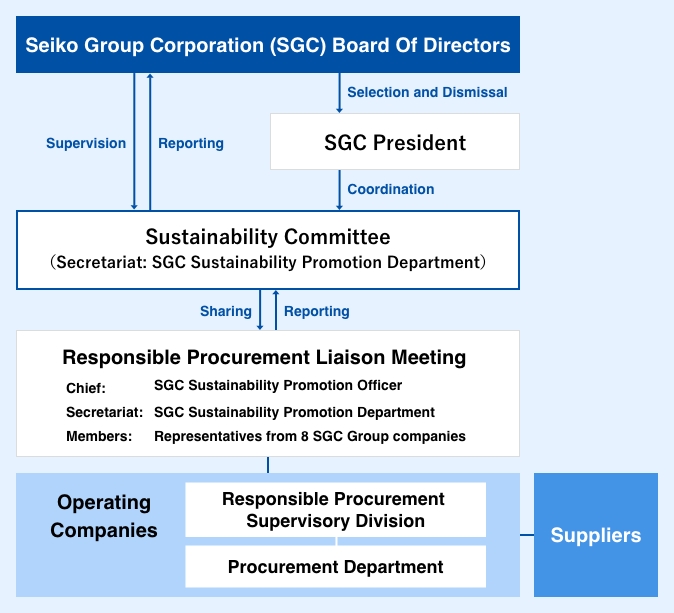
Sustainability Promotion Structure and System
To further promote supplier engagement, a Responsible Procurement Liaison Meeting was established under the Sustainability Committee in fiscal year 2023.
Initiatives
Supplier Briefings
To promote sustainable procurement activities throughout the supply chain, we distribute explanatory videos for our suppliers on the Seiko Group Procurement Guidelines.
In fiscal 2024, following a lecture by an external expert on the background and necessity of sustainable procurement activities, we provided an explanation of the Seiko Group Procurement Guidelines and outlined future initiatives and requests.
Selection of Most Important & Important Suppliers
The Seiko Group designates suppliers that meet certain conditions (e.g., "suppliers of important raw materials and components," "suppliers that are difficult to replace," "suppliers registering large transaction amounts,” etc.) as either “Essential” or “Important” suppliers, and works with them intensively. Additionally, we classify suppliers that provide materials of concern from countries or regions that are listed in the U.S. Department of Labor's List of Goods Produced by Child Labor or Forced Labor as human rights high-risk suppliers, and we work with them on the same level as Essential suppliers.
Self-Assessment Questionnaire (SAQ) Survey
To identify risks in the supply chain, in fiscal 2023 we began conducting SAQ surveys for suppliers.
In this SAQ survey, we confirmed whether suppliers have policies and guidelines, promotional systems, and initiatives in accordance with the following nine themes:
- Sustainability-related Corporate Governance
- Human Rights
- Labor
- Environment
- Fair Business Practices
- Quality and Safety
- Information Security
- Supply Chain
- Harmonious Coexistence with Local Communities
Starting with the fiscal 2024 survey, we expanded engagement to include key indirect material suppliers and requested their cooperation in SAQ surveys and other initiatives. As with direct material suppliers, when significant risks related to human rights or labor are identified, we implement or request corrective actions to mitigate those risks.
Approach to Evaluating SAQ Survey Results
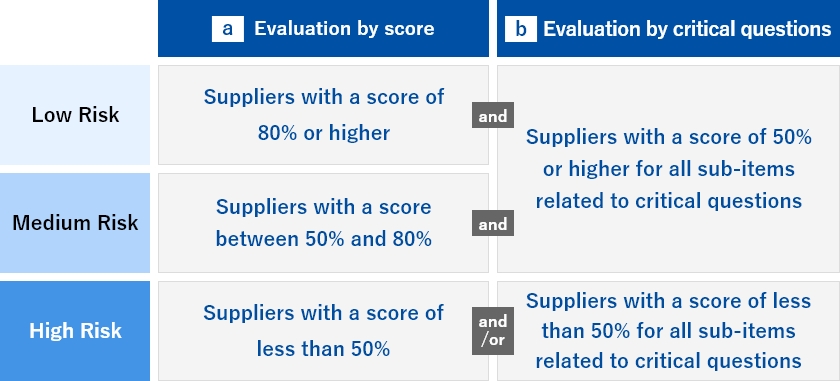
We aim to identify suppliers with risks by tabulating collected responses and analyzing risk trends throughout the supply chain while determining three risk ranks (low risk, medium risk, and high risk) based on each supplier’s total score and responses to critical questions. Among the critical questions we selected for our risk assessments were those related to forced labor, child labor, and long working hours/overwork, which were identified as significant human rights risks through our human rights due diligence.
After the survey, we sent feedback sheets to all suppliers who responded to notify them of the results. For suppliers identified as high risk, we conducted individual interviews to hear directly about the items covered in the SAQ questions.
This is one more way that we are striving to conduct more accurate risk assessment. Additionally, we are establishing a system that enables the entire Group to work on risk mitigation for problems that may arise in the future.
In the survey in fiscal year 2024, we received responses from approximately 180 suppliers. The percentage of suppliers designated as low risk increased 12% from the previous fiscal year.
Grievance Consultation Office for Supply Chain Firms (Reporting Desk for Business Partners)
In order to promote sustainable procurement activities together with our business partners, our Group has become a full member of the Japan Center for Engagement and Remedy on Business and Human Rights (JaCER). Our aim is to establish an effective grievance & redress mechanism throughout our supply chain. JaCER provides a non-judicial “dialogue and grievance redress platform” that complies with the United Nations Guiding Principles on Business and Human Rights.
Our Group uses this dialogue and redress platform to receive complaints and provide advice on human rights issues or violations at our business partners that are caused by Seiko Group managers and/or employees, as well as issues that have occurred or are still occurring within our partner companies.
In this system it is possible for plaintiffs to report abuses anonymously. We will also use a neutral, third-party contact point outside the Seiko Group in order to assure a fair and transparent grievance mechanism.
Initiatives Pertaining to Conflict Minerals
The Seiko Group formulated the Seiko Group Responsible Mineral Procurement Policy in November 2023 to ensure that it does not use minerals that were mined in conflict zones which may be complicit in human rights infringements and conflicts by armed groups. The policy stipulates the promotion of the responsible mineral procurement based on the OECD Due Diligence Guidance for Responsible Supply Chains of Minerals from Conflict-Affected and High-Risk Areas, as established by the Organisation for Economic Co-operation and Development (OECD). In fiscal year 2024, we assessed the mineral procurement status and the level of transparency in the mineral supply chain within the Group. Based on this assessment, we identified tin, tantalum, tungsten, and gold (3TG), as well as cobalt, diamonds, and colored gemstones (ruby, sapphire, and emerald), as the minerals to be included in the scope of upcoming surveys.
Seiko Group Responsible Mineral Procurement Policy
Mineral resources (such as tin, tantalum, tungsten, gold, etc.) mined in conflict-affected and high-risk areas (CAHRAs) carry inherent risks, including potential involvement with armed groups, human rights violations, environmental degradation, and corruption.
Our Group is committed to promoting responsible mineral procurement in accordance with the OECD Due Diligence Guidance for Responsible Supply Chains of Minerals from Conflict-Affected and High-Risk Areas. We aim to ensure that our activities do not contribute to conflicts, human rights violations, or any related issues.
- We will establish an internal management system for responsible mineral procurement.
- We request our business partners to procure minerals in compliance with the Responsible Minerals Assurance Process (RMAP).
- Using the Responsible Minerals Initiative (RMI) questionnaire, we will examine the supply chain, including identifying the origin of minerals and refining facilities.
- If this investigation reveals significant risks, we will take corrective measures together with our business partners, such as requesting changes in the supply chain.
- We will ensure appropriate disclosure of information to stakeholders regarding our efforts in responsible mineral procurement.
We ask our business partners to actively collaborate with the Seiko Group in our commitment to responsible mineral procurement.