Water Resources
Relevant SDGs
Water is a finite and precious resource. We strive to understand and manage risks appropriately while making effective use of water resources and preventing pollution.
Policy and Basic Approach
Water is a finite and precious resource. The combination of economic growth and population growth in developing countries is already straining water supplies, and demand is expected to rise much further. In addition, global warming is decreasing the supply of this vital natural resource, leading to growing concerns about worldwide water scarcity.
In our Group as well, water resources are indispensable for manufacturing, which makes the responsible management of water a crucial management task. We fully understand the impact of our business activities on water resources, and thus strive to use water as efficiently as possible and maximize our efforts to prevent pollution.
We actively promote recycling and reduction in our manufacturing processes. We set strict targets for each business unit’s water reduction efforts. Our internal standards for wastewater are far stricter than those required by government regulations, and we are always working to reduce the use of chemical substances that might cause pollution. Each unit is responsible to ensure that all its employees have access to safe drinking water and that the surrounding community is treated in the same way as our own employees.
Needless to say, our water management responsibilities are not limited to our Group companies. The "Seiko Group Procurement Policy" and "Seiko Group Procurement Guidelines” govern all aspects of our interactions with our supply chain, which includes proper water management.
Going forward, we will continue to strengthen environmental awareness among our employees. We aim to promote greater understanding of the potential risks that manufacturing businesses such as ours can pose to water resources, and to teach everyone the importance of conserving and responsibly managing these gifts of Nature.
Promotion System
Important matters related to water resources are discussed and resolved in the Sustainability Committee, which was established to facilitate the formulation of policies related to the Seiko Group's sustainability, and to carry out activities based on those policies. Resolutions made in the Sustainability Committee are reported to the Board of Directors, which oversees the Committee and regularly discusses the status of related issues, including water resources.
Assessment of Water Risks
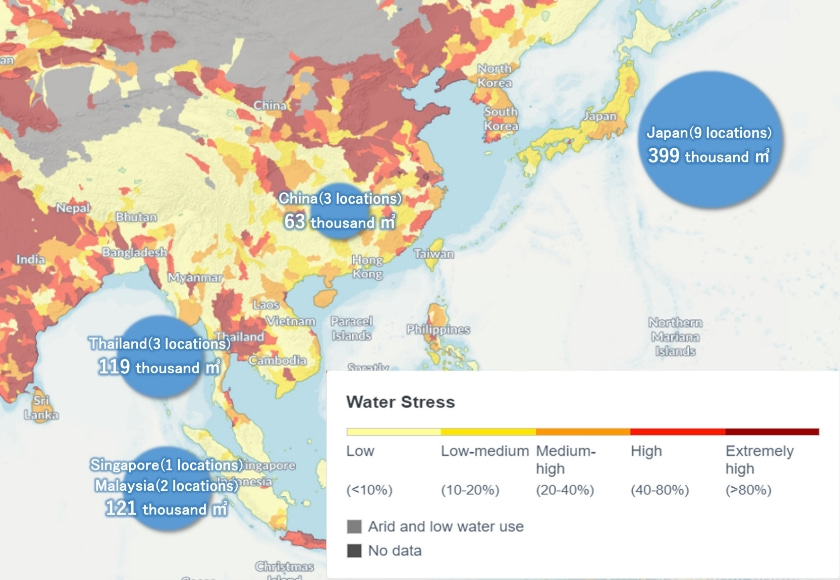
We conducted internal assessments at all Group production sites, using the Aqueduct tool developed by the World Resources Institute (WRI) and the Water Risk Filter from the World Wildlife Fund (WWF), two standard tools for water risk assessment. These investigations covered not only the current situation, but also projections up to the year 2030. They revealed that five overseas sites (three in Thailand and two in China) are located in regions with high water stress. The total water withdrawal at these sites in fiscal year 2024 amounted to 174 thousand ㎥, accounting for 24.7% of the total water withdrawal of our Group (based on FY2024 figures).
Furthermore, each business unit within our Group is currently identifying risks related to floods and other critical events, both for themselves and their primary suppliers, and formulating appropriate responses.
We will continue our efforts to understand and address water risks throughout our manufacturing facilities and supply chain.
* These sites have been determined to have High and Extremely High Water Stress risk profiles according to WRI Aqueduct metrics.
Water Withdrawals and Water Stress in Fiscal Year 2024
Goals
As our Group continues to grow, we want to contribute to the improvement of our shared environment. As one small step toward that end, we have been working to reduce the amount of water our Group companies use each year.
We set a target of a 5% reduction in water withdrawal (per unit of sales) in FY2026 compared to a base year of FY2021. This target aims to promote the sustainable use of water resources and reduce our environmental impact while at the same time aiming for further growth in our business. In this way, we hope to make a small contribution to the betterment of our world and build a more sustainable Group.
We will continue striving to make more efficient use of water resources and to gradually reduce our water withdrawal.
Water withdrawal Targets
FY2026
| Water withdrawal | 5% reduction compared to FY2021 results | (FY2021 results: 791,000㎥) |
|---|---|---|
| Water withdrawal per unit of sales | FY2021 or less | (FY2021 results: 0.33 thousand ㎥ per hundred million yen) |
Summary of Fiscal Year 2024
Water Withdrawal
Water is a valuable natural resource, and we have continued our efforts to use it wisely.
In addition to daily water-saving practices, we promote recycling of purified water in the component cleaning process.
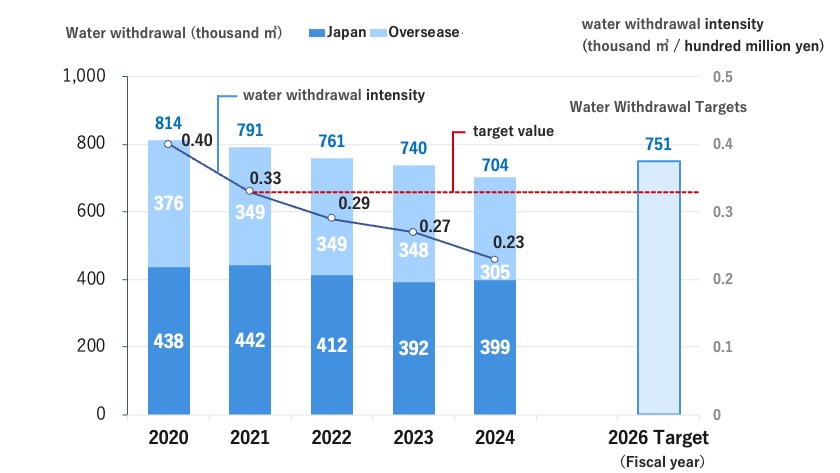
As a result, in fiscal 2024, water withdrawal increased by 1.7% in Japan, but decreased by 12.4% overseas, for an overall decrease of 5.0%, which equals a reduction of 37,000 ㎥.
Due to increased sales, the water withdrawal per unit of sales revenue also improved, decreasing from 0.27 thousand ㎥ per 100 million yen in FY2023 to 0.23 thousand ㎥ per 100 million yen the following year.
Wastewater Management
We have established voluntary standards for wastewater management and treat wastewater through our own dedicated treatment facilities.
We also monitor wastewater conditions daily to ensure full compliance with legal discharge standards.
In fiscal 2024, no violations of regulations concerning water volume or water quality were reported at any of our Group’s production sites.
Looking ahead, as part of our efforts to further reduce total water withdrawal, we plan to conduct on-site interviews at production facilities to gain a more detailed understanding of their water usage.
Water withdrawal and Water withdrawal intensity
■Scope of Aggregation
The data covers Seiko Group Corporation, Wako Co., Ltd., and 30 Group companies (20 in Japan and 10 overseas) engaged in technology, product development, and manufacturing.
Tenants such as retail stores and sales offices where water withdrawal data is difficult to obtain are excluded from the aggregation.
■Aggregation Targets : The data includes tap water, industrial water, and groundwater withdrawn at each site.
No other water sources are included.
・Water Withdrawal Volume Target : Reduce total water withdrawal by 5% (compared to FY2021) by the end of FY2026
・Intensity Target : Keep water withdrawal per unit of sales revenue at or below the FY2021 level (0.33 thousand ㎥ per 100 million yen)
●Note: Due to rounding, totals may not match the sum of component parts.
Examples
All Group companies are working toward reducing water withdrawal.
Manufacturing companies are promoting water circulation initiatives, such as recycling of purified water, while office-based sites are implementing employee awareness campaigns to encourage daily water conservation and introducing water-saving equipment.
SII Crystal Technology Inc. utilizes purified water in its parts cleaning process. After cleaning, the water is collected and, instead of being discharged, undergoes a purification and recycling process. The recycled water is then reused in the cleaning process. This system allows for the annual circulation and reuse of approximately 24.6 thousand cubic meters of water.
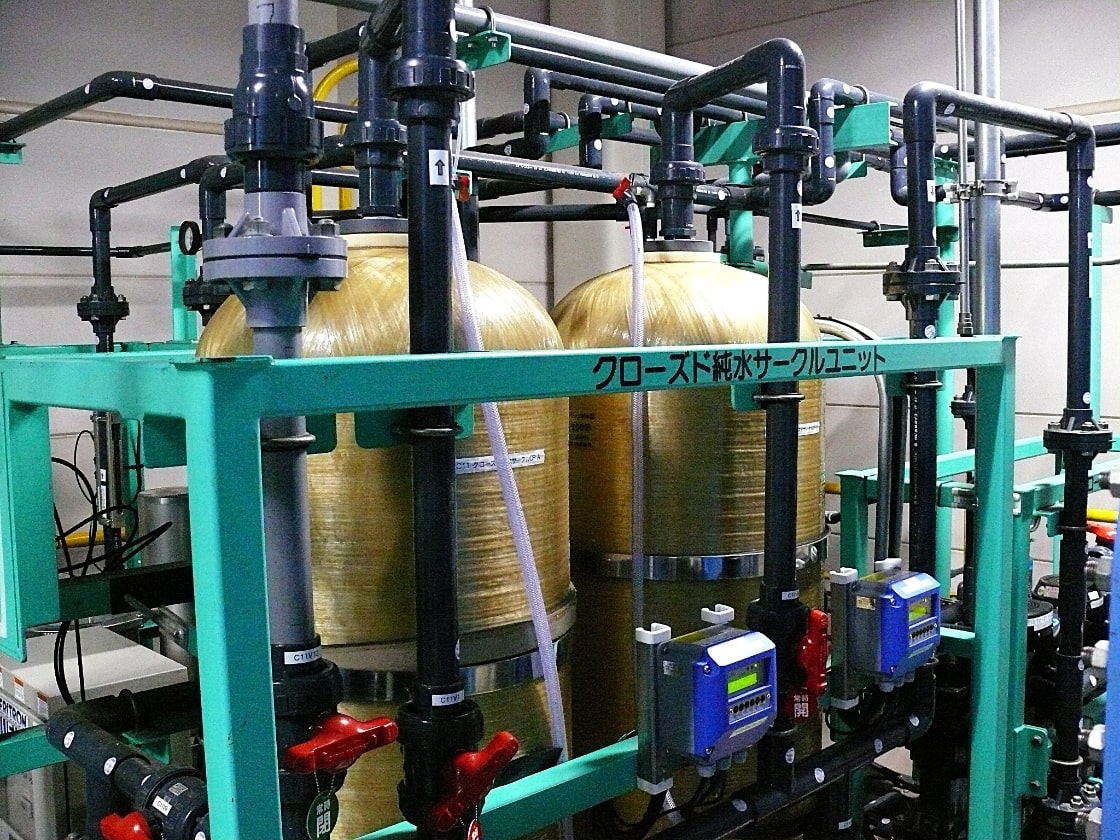
Image: Part of the purified water recycling system.