
Information Disclosure Based on TNFD Recommendations
The Taskforce on Nature-related Financial Disclosures (TNFD) is an international initiative established to develop a framework for assessing and disclosing nature-related dependencies, impacts, risks, and opportunities associated with business activities. TNFD published its Final Recommendations in September 2023.
Because we recognize the importance of addressing these issues, the Group supported these principles and registered as a TNFD Adopter in October 2025. In line with the Final Recommendations, we have clearly identified nature-related dependencies, impacts, risks, and opportunities associated with our business activities and have been steadily improving our disclosures. We have identified priority-target locations within the manufacturing sites of our principal businesses and conducted local assessments of those ecosystems. Going forward, we will expand assessments across the entire value chain and take steps to properly address any risks we identify.
We will also periodically evaluate the progress of our initiatives and continue to enhance the scope and quality of our disclosures.
General Requirements
| General Requirements | Our Approach | |
|---|---|---|
| 1 | Application of Materiality | When we identify and assess nature-related issues, we use TNFD's LEAP approach, a process for analyzing dependencies and impacts on nature as well as the associated risks and opportunities. We use a double materiality approach that considers two dimensions: the impact of our business on the environment and society, and the financial impact on our business. |
| 2 | Scope of Disclosure | We analyze and disclose nature-related dependencies, impacts, risks, and opportunities associated with the Group's principal businesses. ・We assess nature-related dependencies and impacts across the entire value chain, including upstream, direct operations, and downstream activities, using ENCORE, a tool for analyzing nature-related dependencies and impacts. ・For domestic and overseas manufacturing sites, we identify locations with the highest priority and conduct analyses and assessments that take into account the characteristics of each region. |
| 3 | Locations with Nature-related Issues | We determine whether the manufacturing sites of our principal businesses are located in TNFD-defined areas of concern, and if so, we identify locations that deserve priority attention. |
| 4 | Integration with Other Sustainability-related Disclosures | As disclosures based on TCFD and TNFD contain overlapping elements, we will examine opportunities to streamline and integrate these disclosures in the future. |
| 5 | Time Horizons Considered | In this disclosure, the short-, medium-, and long-term classifications are determined based on the period during which each risk or opportunity is expected to materialize and its impact on the Company's business and financial performance becomes apparent. Short term: 1-2 years, Medium term: 3-9 years, Long term: 10-30 years |
| 6 | Stakeholder Engagement | The Group has established the Seiko Group Human Rights Policy and operates a human rights due diligence process to ensure that our business activities do not infringe upon the human rights of stakeholders. As part of our nature-related initiatives, we also maintain ongoing engagement with local communities surrounding our operating sites. |
Governance
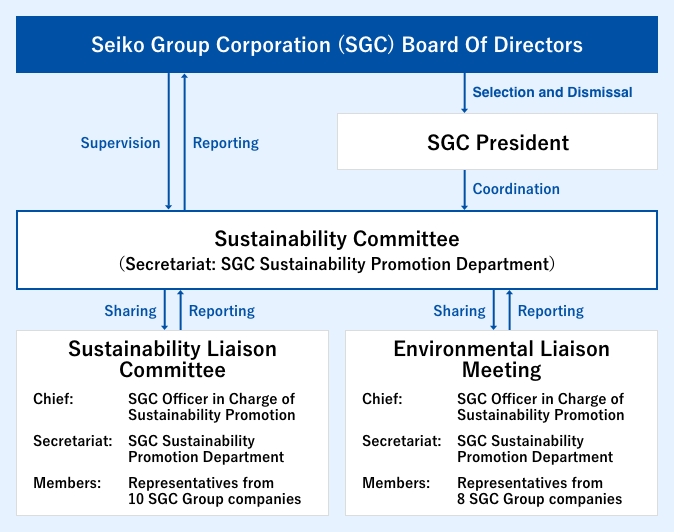
All matters related to material sustainability issues are handled by the Sustainability Committee. The Committee was established to draw up the Group's sustainability-related policies and facilitate the implementation of activities based on those policies. Matters resolved by the Committee are reported to the Board of Directors, which is responsible for overseeing the Sustainability Committee. The Board is genuinely concerned about sustainability issues and regularly discusses matters that relate to how the Company interacts with Nature.
The Group has also established the Seiko Group Human Rights Policy to respect the rights of individuals affected by its business activities. Under the human rights due diligence framework, the Sustainability Committee also reports to the Board of Directors about progress on human rights initiatives.
Promotion Structure
Roles
The Board of Directors
At least once a year, the Board of Directors receives a report from the Sustainability Committee summarizing the latter’s resolutions. The Board is responsible for overseeing the Group’s efforts to address issues and for monitoring progress. It also regularly discusses important matters related to natural capital.President (Executive Responsible for Sustainability)
Matters relating to the Group's materiality, including sustainability issues related to natural capital, are handled at regular Sustainability Committee meetings, which are held twice a year in principle. In addition, extraordinary meetings are convened whenever necessary. Decisions made by the Committee are reported to the Board of Directors, and any actions that follow are managed by the appropriate executive officers.Sustainability Committee
The Committee is chaired by the President, who is ultimately in charge of managing the Group’s natural capital, and consists of full-time officers, including the officer in charge of sustainability promotion, and presidents of Group companies. Matters related to the Group's materiality, including important issues related to natural capital, are discussed and resolved at two regular meetings each year, and at extraordinary committee meetings whenever necessary, and the details of those resolutions are reported to the Board of Directors. The officer in charge of sustainability promotion plays a key role in developing and executing programs based on the Sustainability Committee’s decisions.
Strategy
In line with the LEAP approach recommended by TNFD, we assessed the Group’s nature-related dependencies and any impacts associated with our principal business activities, then identified related risks and opportunities as well as potential responses.
First, we identified and assessed potential dependencies and impacts on natural capital throughout the value chain and determined which of those might be material to the Group. We also identified locations among our manufacturing sites that deserve special attention, and conducted questionnaire-based assessments to identify risks and opportunities and to evaluate possible response measures.
Going forward, we will conduct more detailed analyses of both upstream and downstream activities to deepen our assessment of dependencies, impacts, risks, and opportunities across the entire value chain.
LEAP Approach
The LEAP approach is an integrated framework recommended by TNFD for identifying and assessing nature-related issues. It consists of four stages: Locate, Evaluate, Assess, and Prepare.
-
Locate
- Identify nature-related dependencies and impacts associated with the Group's business activities using analytical tools such as ENCORE.
- Investigate how the Group's manufacturing sites interact with nature, and identify locations that should be prioritized for assessment based on business significance.
-
Evaluate
- Identify material nature-related dependencies and impacts within the Group.
-
Assess
- Assess risks and opportunities by examining nature-related dependencies and impacts, questionnaire survey results, and potential impacts on business operations.
-
Prepare
- Consider measures to mitigate risks and capture additional opportunities.
- Examine target-setting strategy.
- Reflect findings in disclosure practices.
Identify locations that merit prioritized examination.
TNFD identifies three key dimensions for areas of concern:
・Biodiversity importance・Ecosystem integrity・Physical water-related risks
Areas considered to have high biodiversity importance are regions that support rare or endemic species and maintain a healthy ecosystem balance. Areas with high ecosystem integrity are natural environments that remain largely intact with limited human disturbance. Physical water-related risks include factors such as high levels of water stress.
The Group recognizes that our manufacturing sites have particularly significant natural dependencies and impacts. Accordingly, we assessed all 17 domestic and overseas manufacturing sites using WWF's Risk Filter Suite v2.0, a biodiversity and water risk assessment tool.
Based on the assessment results and business significance, four domestic sites and four overseas sites were identified as priority locations of concern.
Identification and Assessment of Dependencies and Impacts
Using ENCORE, we identified and assessed potential dependencies and impacts on nature.
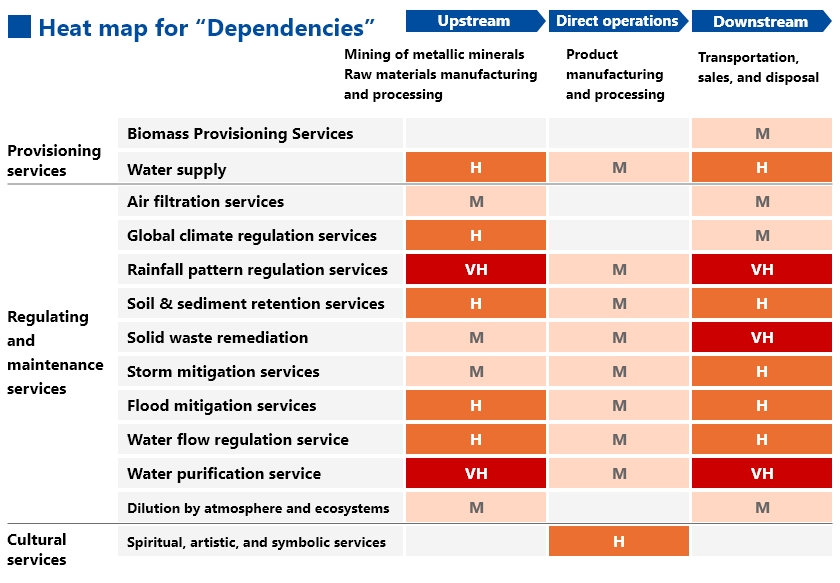
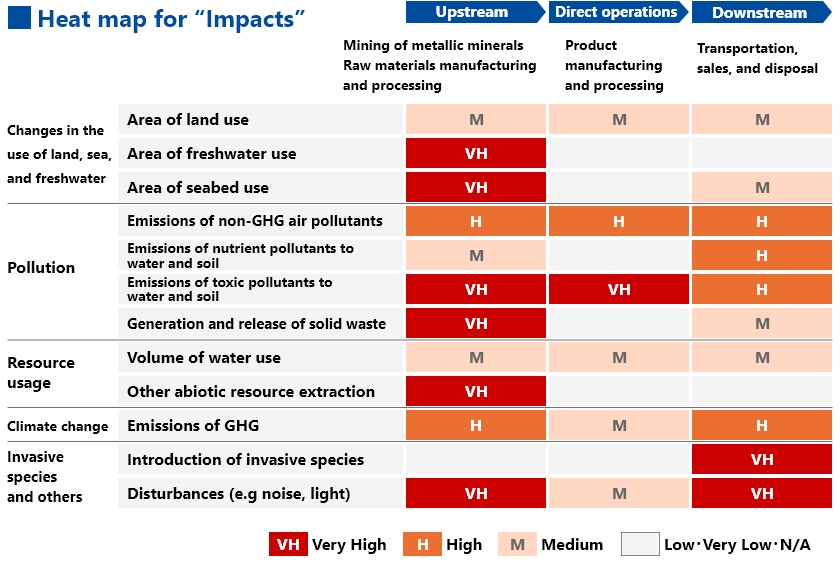
For the Group's principal businesses, we identified ecosystem-related services across the value chain that are closely related to our business activities. Dependencies and impacts were categorized as Very High, High, Medium, Low, Very Low, or N/A, and summarized in a heat map.
In certain cases, ENCORE assessment results were revised based on qualitative evaluations reflecting the actual conditions of the Group's value chain. Some assessment results were also updated compared with the previous assessment.
As a result, from the perspective of dependencies on nature, we identified the possibility that activities upstream in the value chain, including the mining of metal and mineral resources and the processing of raw materials, depend on ecosystem-related services such as rainfall pattern regulation and water purification. Downstream activities, including transportation and disposal, may likewise depend on rainfall pattern regulation and water purification, as well as ecosystem-related services such as the remediation of solid waste.
From the perspective of impacts on nature, we identified the possibility that upstream metal and mineral mining may affect freshwater and marine environments through changes in land use, may contribute to water and soil pollution through waste, and may involve the extraction of abiotic resources. We also identified the possibility that our direct operations have further impacts through water and soil pollution.
We also conducted surveys at our eight domestic and overseas priority locations to assess local environmental conditions and impacts on nature. We evaluated site-specific circumstances, including pollution control measures, land-use changes, awareness of native and invasive species, and procurement of high-impact commodities.
The survey confirmed that each business location is taking ongoing steps to reduce its impact on nature, including such things as wastewater management over and above regulatory requirements, prevention of soil contaminant leakage, waste reduction efforts, and restoration of lands that have been damaged by business operations.
At the same time, we recognized the need to further strengthen initiatives related to sustainable water management, including water reuse and recycling systems, as well as management of procured high-impact commodities.
* High-impact Commodities:Raw materials and resources that have a high potential to place significant pressure on ecosystems and biodiversity during production, extraction, or processing.
Changes to Evaluation Results
Items Modified from the ENCORE Assessment Results
| Process | Dependence on Nature | Change from ENCORE Assessment | Rationale |
|---|---|---|---|
| Raw Materials Manufacturing and Processing | Spiritual, Artistic, and Symbolic Services | VH → N/A | As raw materials in upstream processes are limited to industrial applications, with no dependence on artistic services, the assessment was designated as N/A. |
| Product Manufacturing and Processing | Spiritual, Artistic, and Symbolic Services | N/A → H | Direct operations, including watch design, draw inspiration from nature; therefore, the dependence was assessed as High (H). |
| Transportation, Distribution, and Disposal | Other Supply Services – Animal-based Energy | M → N/A | Dependence on animal-based energy for land transportation is not material; therefore, the assessment was designated as N/A. |
| Transportation, Distribution, and Disposal | Recreation-related Services | VH → N/A | Logistics and transportation activities do not involve tourism, leisure, or similar services that rely on natural environments; therefore, the assessment was designated as N/A. |
| Transportation, Distribution, and Disposal | Visual Amenity Services | VH → N/A | Logistics and transportation activities do not use services based on the value of natural landscapes; therefore, the assessment was designated as N/A. |
Items for Which the Assessment Was Lowered from the Previous Assessment
| Process | Dependence on Nature | Change from Previous Assessment | Rationale |
|---|---|---|---|
| Product Manufacturing and Processing | Nutrient Pollutant Discharges to Water and Soil | M → N/A | In the previous assessment, the ENCORE rating was changed from N/A to Medium (M) in light of the potential impacts associated with watch manufacturing processes. However, operational investigations revealed the actual impact to be limited, and therefore the original ENCORE assessment has been retained. |
* As the scope of businesses covered in the assessment was expanded compared with the previous assessment, some items received higher ratings.
Identification and Assessment of Risks and Opportunities
Based on the assessment of the Group's dependencies and impacts on natural capital, we identified the following risks and opportunities that are likely to have a significant financial impact on our principal business activities. For each risk and opportunity, we examined possible steps to avoid and mitigate risks and to realize opportunities.
The Group does not handle genetic resources as defined in the Ministry of the Environment's Access and Benefit-Sharing (ABS) Guidelines, specifically, valuable materials derived from plants, animals, microorganisms, or other organisms that contain functional units of heredity. We have confirmed that there are no such ABS-related issues within our business operations. Therefore, ABS-related risks have not been identified as principal nature-related risks.
* ABS: A framework that ensures the fair and equitable sharing of benefits arising from the use of genetic resources. It is recognized as an important issue related to biodiversity.
| Risk Classification | Details of Risks | Time Horizon* | Key Response Measures | ||
|---|---|---|---|---|---|
| Risk | Physical | Acute | Increased frequency and severity of flooding resulting in operational shutdowns at business sites, higher recovery costs, supply chain disruptions, and reduced production volumes and revenues. | Short-term~Medium-term | ・Continuously review and improve existing Business Continuity Plans (BCPs). ・Diversify suppliers and promote transactions with suppliers that have no history of flood-related damage. ・Prevent delivery delays by maintaining appropriate safety stock, and ensure business continuity by securing alternative components and manufacturing sites in the event of flooding. |
| Operational disruptions caused by nearby wildfires and reduced productivity due to difficulties performing outdoor work, leading to decreased revenues. | Short-term~Medium-term | ・Develop BCPs that address wildfire scenarios. ・Protect employee health and review outdoor work environments in preparation for wildfires. ・Conduct employee evacuation drills and joint emergency response exercises with local governments and fire departments. |
|||
| Chronic | Water shortages and deteriorating water quality caused by droughts and ecosystem degradation resulting in water consumption restrictions, increased water treatment costs, operational interruptions, and reduced profitability. | Medium-term~Long-term | ・Promote daily water conservation efforts and recycle purified water at manufacturing sites. ・Manage wastewater based on internal standards and comply with all applicable laws and regulations. |
||
| Increased employee health risks and reduced productivity due to extremely hot days, together with increased air conditioning and maintenance costs, resulting in lower profitability. | Medium-term~Long-term | ・Thoroughly implement measures to prevent heatstroke among employees. ・Install highly efficient air-conditioning systems and promote use of insulation and other heat-shielding measures. |
|||
| Transition | Policies & Regulations | Stricter wastewater discharge regulations aimed at protecting endangered river species, together with resulting fines and operational shutdowns may lead to increased capital expenditures. | Short-term~Medium-term | ・Comply with all environmental regulations (including internal standards) and prevent leakages. ・Identify pollutant leakage risks and implement drills for anticipated emergency scenarios. ・Improve production technologies that reduce chemical use and prevent water resource contamination through water recycling. |
|
| Increased costs associated with switching from groundwater to municipal water supplies due to groundwater restrictions or source depletion, as well as increased operating costs and business constraints caused by water-use restrictions and rising water prices. | Medium-term~Long-term | ・Manage and use water resources efficiently according to region-specific issues such as water stress and local regulations. ・Promote water recycling and purified water regeneration technologies. ・Consider water-saving measures when introducing new machinery and equipment. |
|||
| Increased manufacturing costs, management burdens, and advanced treatment requirements due to stricter waste management and circular economy regulations driven by concerns over environmental pollution. | Short-term~Medium-term | ・Comply with international regulations relating to raw materials. ・Reduce or replace plastics, foamed materials, and similar materials in packaging and containers. ・Reduce use of plastic materials in products and promote recycling. |
|||
| Risk | Transition | Market・Technology | Higher procurement costs and increased product development expenses associated with changes in sourced materials to meet growing demand for sustainable raw materials driven by customer environmental preferences. | Medium-term~Long-term | ・Promote selection of raw materials and standardization of designs in anticipation of future regulations and customer requirements. ・Gradually introduce sustainable raw materials and cost control through collaboration with suppliers. |
| Delays in adopting technologies and low-environmental-impact materials required to meet enhanced environment-friendly procurement standards may lead to a mismatch with market needs, failure of suppliers to meet procurement standards, and the risk of losing customer support. | Medium-term~Long-term | ・Improve information gathering and diversification of raw material suppliers. ・Monitor and proactively respond to increasingly stringent environmental requirements and trends. ・Transition to certified materials such as Forest Stewardship Council (FSC)-certified materials, and increase the use of recycled materials. |
|||
| Reputation | Damage to protected natural areas or endangered species around operational sites due to environmental pollution may result in a loss of trust from local communities, damage to corporate reputation, and reduced revenues. | Medium-term~Long-term | ・Comply with environmental laws and regulations (including internal standards) and prevent leaks and spills of hazardous substances. ・Conduct emergency response drills for hazardous substance leak and spill scenarios. ・Strengthen equipment management through preventive maintenance. |
||
| Complaints from local residents regarding smoke emissions from factories may damage the corporate image and result in reduced revenues. | Medium-term | ・Comply with environmental laws and regulations (including internal standards) and prevent leaks and spills of hazardous substances. ・Strengthen equipment management through preventive maintenance. ・Enhance disclosure regarding the Group's pollution prevention initiatives. |
|||
| Liability | Liability for environmental contamination caused by non-compliance with environmental laws or accidental leaks of hazardous substances, as well as compensation claims from business partners resulting from operational shutdowns could significantly depress profits. | Short-term~Long-term | ・Comply with environmental laws and regulations (including internal standards) and prevent leaks and spills of hazardous substances. ・Conduct emergency response drills for hazardous substance leak and spill scenarios. ・Establish environmental management systems, and reinforce periodic monitoring. |
||
| Opportunity Classification | Opportunity Details | Time Horizon* | Key Response Measures | ||
| Opportunities | Resource Efficiency | Reduced operating costs through the introduction of production technologies that use recycled materials and contribute to the reduction of greenhouse gas (GHG) emissions. | Medium-term~Long-term | ・Introduce energy-efficient equipment and manufacturing processes. ・Adopt product designs that use recycled materials. ・Identify CO₂ reduction measures throughout the product life cycle and review operational processes. |
|
| Stable production and cost reductions through the introduction of facilities and equipment that promote water conservation and water recycling. | Medium-term~Long-term | ・Monitor water withdrawal intensity per unit of revenue and consider ways to improve those figures. ・Install water circulation and recycling systems. ・Install water-saving equipment and technologies. |
|||
| Products and Services | Enhanced competitive advantages and improved revenue growth thanks to products and services that deliver environmental value, including eco-conscious design, energy efficiency, longer product life, and repair and refurbishment services, as well as through the use of sustainable materials. | Medium-term~Long-term | ・Design environmentally conscious products based on internal certification systems. ・Differentiate products through miniaturization, extended lifespans, and improved energy efficiency. |
||
| Improved resilience and strengthened ability to address procurement and regulatory risks through the development of alternative materials to replace high-impact commodities, and the reduction of dependence on natural resources. | Long-term | ・Continue research and development of alternative materials to replace mineral resources with high dependencies on nature or high environmental impacts. ・Diversify and expand list of suppliers to prepare for tighter regulations and price fluctuations. |
|||
| Market | Gain market recognition and increase revenue from products related to biodiversity conservation, such as forest conservation and marine conservation activities | Short-term~Long-term | ・Promote forest conservation activities through tree-planting initiatives in collaboration with governmental bodies. ・Promote marine conservation activities through collaboration with NGOs. ・Develop products linked to forest conservation and marine protection activities. |
||
| Reputation | Stronger relationships with local communities and enhanced corporate value through activities that generate positive impacts for both nature and society. | Short-term~Long-term | ・Participate in initiatives such as the 30by30 Alliance for Biodiversity. ・Enhance corporate value through co-creation with stakeholders, including afforestation and nature conservation activities conducted in collaboration with governments, universities, and NGOs. ・Implement outdoor programs such as nature observation events on company premises. |
||
| Resilience | Reduced costs and improved business continuity through environmentally responsible operations and the transition to highly efficient production processes. | Long-term | ・Promote effective use of resources and reduction of waste. ・Promote daily water conservation efforts and recycle purified water at manufacturing sites. ・Replace older manufacturing equipment with more energy-efficient equipment. |
||
* Short-term: 1-2 years, Medium-term: 3-9 years, Long-term: 10-30 years
Risk and Impact Management
In order to centrally manage risks that could have a significant impact on the Group's business, the Seiko Group Risk Management Committee, chaired by the President of the Seiko Group, plays a central role in developing and strengthening the Group-wide risk management system. In order to promote Group-wide risk management through close cooperation between Seiko Group Corporation (SGC) and its various Group companies, SGC established a Group Risk Management Committee, comprised of the presidents of each Group company, and also established a system to identify and share risks for the entire Group.
We assess nature-related dependencies, impacts, risks, and opportunities in accordance with the TNFD's LEAP approach.
Particularly significant dependencies, impacts, risks, and opportunities are regularly identified, evaluated, and approved by the Sustainability Committee. Matters approved by the Sustainability Committee are subsequently reported to the Board of Directors, and risks approved by the Sustainability Committee are reported to the Company's Risk Management Committee.
Going forward, in addition to our direct operations, we will also conduct more detailed analyses of our upstream and downstream value chains to identify and assess nature-related dependencies, impacts, risks, and opportunities. Based on these analyses, we will develop response measures, obtain approval from the Sustainability Committee, and proceed with their implementation.
Group Risk Management Promotion System
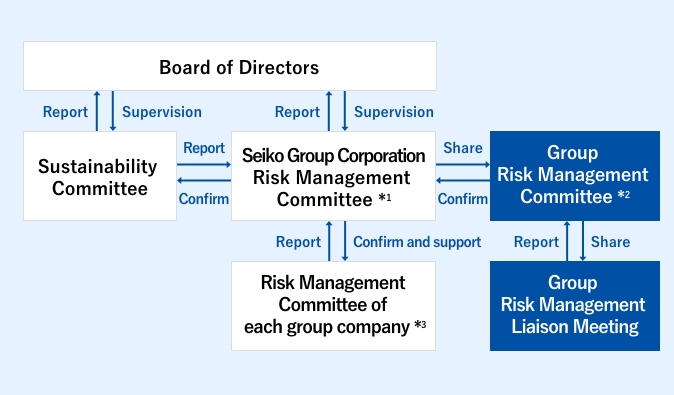
Roles
Seiko Group Risk Management Committee ※1
Chaired by the President, the Committee is working to identify and respond to risks that need to be addressed across the Group. In addition, it receives reports from all the Group risk owners, including at SGC, and supports ongoing risk management at each company.Group Risk Management Committee ※2
Comprised of full-time officers and the presidents of Group companies, this Committee identifies and provides information about risks for the entire Group, monitors responses to key risks, and shares information among all participants.Risk Management Committees of Group Companies ※3
Each Group company promotes risk management autonomously, led by their own risk management committee.Sustainability Committee
The Committee discusses and decides on matters related to the Group's materiality, including Nature-related dependencies and impacts, as well as risks and opportunities, and reports the details of these decisions to the Board of Directors. In addition, it reports to the Seiko Group Risk Management Committee on the progress of measures to alleviate or eliminate risk.
Metrics and Targets
The Group quantitatively monitors nature-related metrics, including greenhouse gas (GHG) emissions, water withdrawal, waste generation, and recycling rates. With respect to GHG emissions, the Group has set targets for FY2030 to reduce Scope 1 and Scope 2 emissions by 42% and reduce Scope 3 emissions (Categories 1 and 11) by 25%, both relative to FY2022 levels. The Group also aims to achieve net-zero emissions by FY2050. With regard to water resources, the Group has established targets for FY2026 of reducing total water withdrawal by 5% compared with FY2021 levels and maintaining water withdrawal intensity per unit of revenue. For resource recycling, the Group has set a target of achieving a recycling rate of 90% or higher at domestic sites by FY2030. While continuing efforts toward achieving these targets, the Group will consider establishing additional metrics and targets aligned with TNFD disclosure recommendations.
| Metric No. | Metric | Group Internal Metric | Disclosure Location | Target | |
|---|---|---|---|---|---|
| - | GHG Emissions | Scope1 | ESG Data Greenhouse Gas (GHG) Emissions |
FY2030 Scope 1 and Scope 2: 42% reduction compared with FY2022 levels |
|
| Scope2 | |||||
| Scope3 | FY2030 25% reduction compared with FY2022 levels Applicable Categories: Category 1 and Category 11 |
||||
| A3.0 | Total Water Consumption and Water Withdrawal | Water Withdrawal | Municipal Water Supply | ESG Data Water |
FY2026 Water Withdrawal 5% reduction compared with FY2021 levels Water Withdrawal Intensity per Unit of Revenue At or below the FY2021 level |
| Industrial Water Supply | |||||
| Groundwater | |||||
| Total Water Withdrawal | |||||
| C2.1 | Wastewater Discharge | Wastewater Volume | River Discharge | - | |
| Sewer Discharge | |||||
| Total Wastewater Discharge | |||||
| BOD | ESG Data BOD、COD |
- | |||
| COD | - | ||||
| C2.2 | Waste Generation and Treatment | Amount of Waste Generated and Recyclables | ESG Data Waste and Recyclables |
- | |
| Recycling Rate | Recycling Rate (Domestic Sites): 90% or higher by FY2030 | ||||
| C2.4 | Air Pollutant Emissions Other Than GHG |
NOx Emissions | ESG Data NOx、SOx |
- | |
| SOx Emissions | |||||