

Seiko Time White Paper 2026: Differences in Time Perception
— Summary —

Based on Seiko Group Corporation’s guiding desire “for each individual to enjoy more fulfilling time in their own way,” the Company has been conducting an annual survey on people’s perceptions of time since 2017, and publishing the results as a “Seiko Time White Paper” each year.
The research is supervised by time studies expert Prof. Makoto Ichikawa of the Graduate School of Humanities at Chiba University. Dr. Ichikawa, who specializes in experimental psychology, has been conducting research on the characteristics of human perception of time and space, cognition, and sensory experience. His recent work focuses on perceptual and cognitive processing of temporal and spatial information in visual and auditory systems.
The 2026 survey was conducted in Japan from April 6-9, using an online questionnaire. The survey selected 600 male and 600 female respondents, divided into age groups from 15 to 69, with equal numbers of participants in each group. Some questions included an additional 200 high school students.
As this year marks the 10th edition of the survey, the report also reviews longitudinal data to analyze how modern attitudes toward time have evolved in the past decade. Although this time frame is relatively short, Dr. Ichikawa’s research showed a number of interesting trends, all pointing to the normalization of efficiency (what he calls “time performance”) in our daily lives, as well as an increase in our desire for less “efficient” and more personally fulfilling time use (termed “emotional satisfaction”). In addition, his data showed a widening sense that our perceptions of time are personal, and so we do not expect others to share our time sense. All of these are significant findings. The past decade of research has clearly shown that, at least within Japanese society, individual time perceptions are changing constantly. It seems fair to extrapolate from this data that other advanced economies in North America and Europe, for example, might experience similar changes.
Finding #1:
Time Performance Has Become the Norm
In the current survey, 65.8% of respondents said that maximizing “time performance” (the effective use of time in daily life) is important, compared with 62% in 2025. One indicator of this upward trend is the exploding use of AI tools in private (not work-related) life. The figure for private AI use jumped to 51.9% from 31.8% just one year ago. Other results:
- 61.0% of respondents are conscious of time performance in their daily life
- 65.8% believe time performance is a social norm
- 39.3% consider efficient use of time to contribute to a rich lifestyle (vs. 28.7% who do not)
- 41.4% feel emotionally satisfied when improving efficient use of time (vs. 27.3% who do not)
- 51.9% use AI in their private lives for purposes such as advice about work, life consultations, and emotional support
Finding #2:
Growing Emphasis on Using Time for Emotional Satisfaction
In this year’s research, 74.3% of respondents said that they need time for “just doing nothing,” while 73.9% said they often want to take time to stop and think about something seriously.
It is both interesting and significant that over 70% of people of all ages say they need time to “do nothing,” or “focus on a single idea,” and sometimes they just “enjoy thinking,” all of which highlights the importance of emotionally satisfying time. Over 60% of respondents showed a growing tendency to switch back and forth between seeking efficient time performance and emotionally satisfying time.
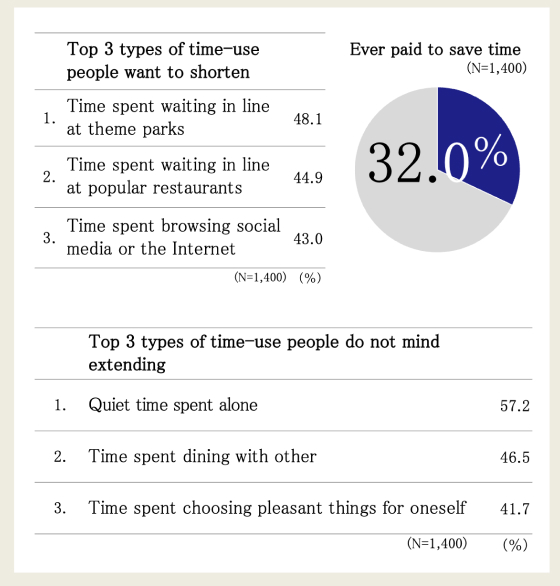
- 32.0% say they have paid money to save time, which shows the value people place on time performance.
- Over 60% say their approach to time use has changed, such as preferring choices they are personally satisfied with or prioritizing comfort over efficiency.
- 63.6% consciously switch between time they want to optimize (time performance) and time that not measured in terms of efficiency (emotionally satisfying time).
Finding #3:
Individual Differences in Time Sense Are Seen as Normal
88.7% of people say that their sense of time differs from that of other people. Thus, it is fair to say that nearly 90% of our Japanese sample (and by extension, other societies as well) feel that “people do not all perceive time in the same way.” This alone is a very significant finding. For example,
- The phrase “a little early” has a variety of meanings depending on the individual. A little over half the sample group (52.6%) understand it to mean “around 10 minutes early,” while 10% interpret it as “5 minutes early” and another 10% take it to mean “20+ minutes early.”
- One in three people struggles when told to act “as soon as possible” (ASAP) because that phrase is equally vague; different people have different interpretations of what it means.
- 88.7% of the sample have experienced mismatches in time sense with others, and 80.8% consider such differences natural.
- 73.4% believe that perceptions of time differ across generations, and 67.0% believe it is OK to share those perceptions only when absolutely necessary.
Insights from Longitudinal Data on How People Experience Time
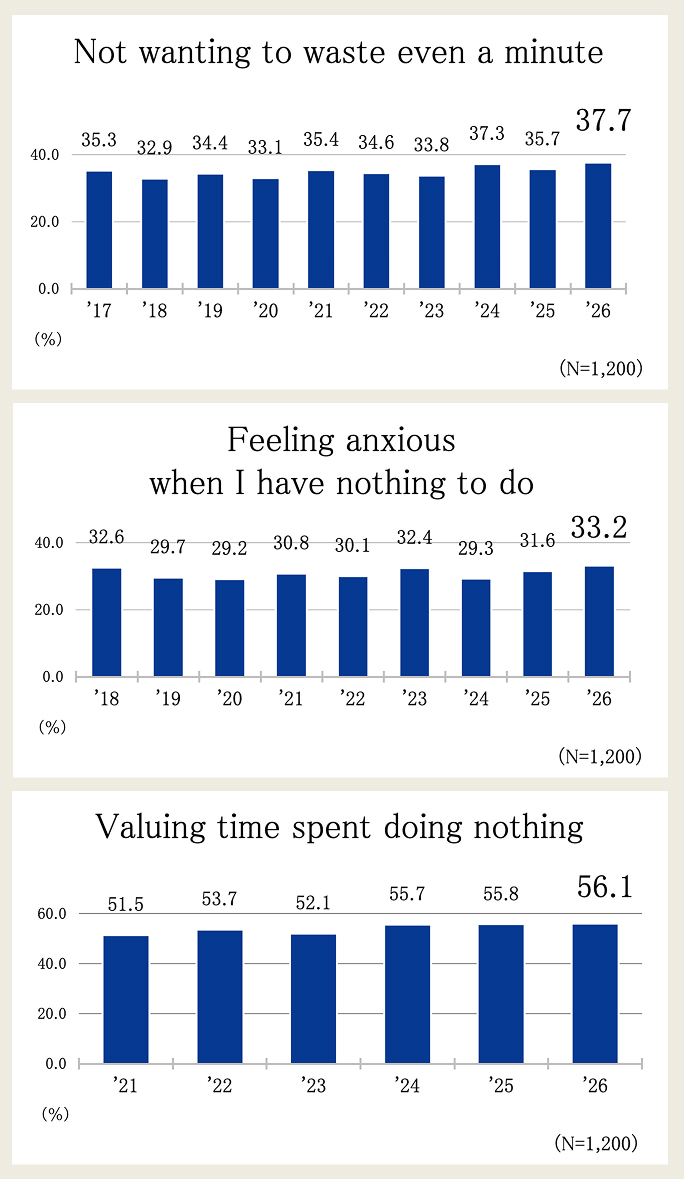
Perceptions such as “being pressed for time” (63.4%) and “not having enough time” (56.7%) remain largely unchanged. The sense of “not wanting to waste even a minute” (37.7%), “feeling anxious when I have nothing to do” (33.2%), and “valuing time spent doing nothing” (56.1%) all reached new highs in 2026. It is clear from this extended data that people are feeling more pressed for time and more conscious of not wasting their valuable time than ever before.

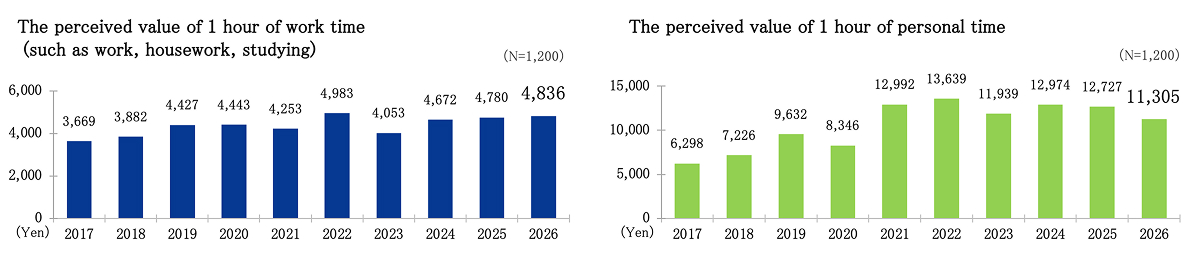
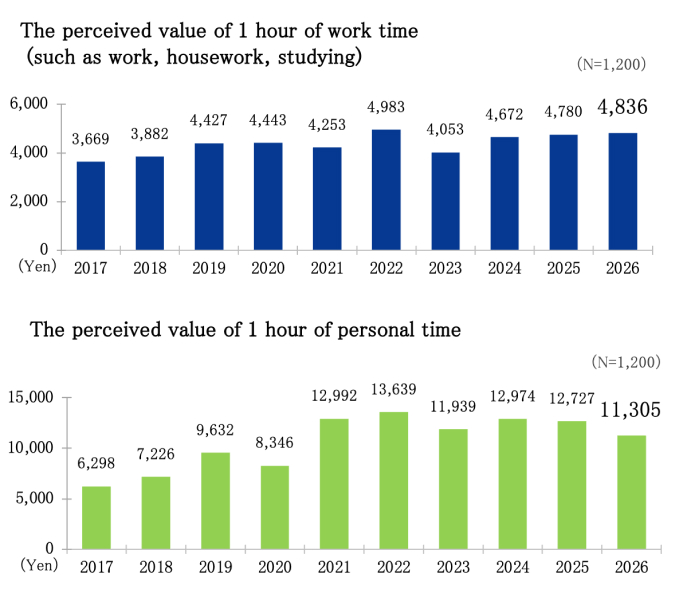
When asked to put a monetary value on their time, people responded with a range of figures. The perceived value of 1 hour of efficiency-driven (time performance) time (such as work, housework, studying) was 4,836 yen, which is roughly in line with data from ten years ago. In short, the value of work time has remained basically flat in recent years. However, the average perceived value of 1 hour of personal (emotional satisfaction) time has declined in the past decade, although it was still a large 11,305 yen.
Note that translating these figures into other currencies may be misleading. What is significant is that despite the downtrend, there is still a nearly 3x higher valuation on personal time over working time.
Conclusions (based on interviews with Dr. Ichikawa)
The results of this survey suggest that people's perceptions of time are becoming more diverse and increasingly flexible. While prioritizing efficiency is now a norm, there is also a growing tendency to value forms of time use that do not intentionally pursue efficiency. The pursuit of efficiency and should not be seen as opposed to a desire for emotional fulfillment and subjective satisfaction. Rather, the two coexist. In many cases, the pursuit of efficiency is a behavioral pattern aimed at creating greater time flexibility. In other words, people strive for efficient use of time so that they can have more free time to enjoy emotional satisfaction. This suggests a growing shift toward a more personalized approach to time use — one rooted in individual values and focused on enhancing emotional fulfillment. This leads to another, also highly significant conclusion.
Our findings showed that nearly 90% of respondents reported experiencing differences in time sense and around 80% believe that such differences are natural. This suggests that time is no longer widely perceived as something inherently shared, but rather as a subjective experience that varies across individuals. While this enables people to act more freely according to their own pace, it also implies fewer opportunities for shared experiences, potentially leading to increasingly fragmented individual experiences and a gradual weakening of social and community ties.
The richness of human experience and culture tends to fragment over time — a cultural version of the principle of entropy. To sustain communities as collective entities, it is important to create opportunities for shared experiences, things such as festivals, world expos, or the Olympics, where people can experience the same thing together. One great challenge for all our societies going forward will be how to design systems and opportunities that counteract this tendency towards personal, individual-centered time sense and foster a greater sense of shared meaning.
Press Contact:
Seiko Group Corporation
Public Relations Department
prdeptj@seiko.co.jp